

Autism is usually approached as a single diagnostic entity. Clinically, that model is insufficient. A diagnosis establishes that a recognizable neurodevelopmental pattern is present. It does not establish that the same mechanisms, functional limitations, or treatment priorities are present in every person who meets criteria.
Autism is heterogeneous. That heterogeneity should change how clinicians assess, formulate, and intervene.
Diagnosis is the beginning of the formulation
The traditional diagnostic question asks whether a person meets criteria for autism spectrum disorder. That question remains necessary, but it is not sufficient. The more useful clinical question asks what developmental pattern is present and what that pattern implies for care.
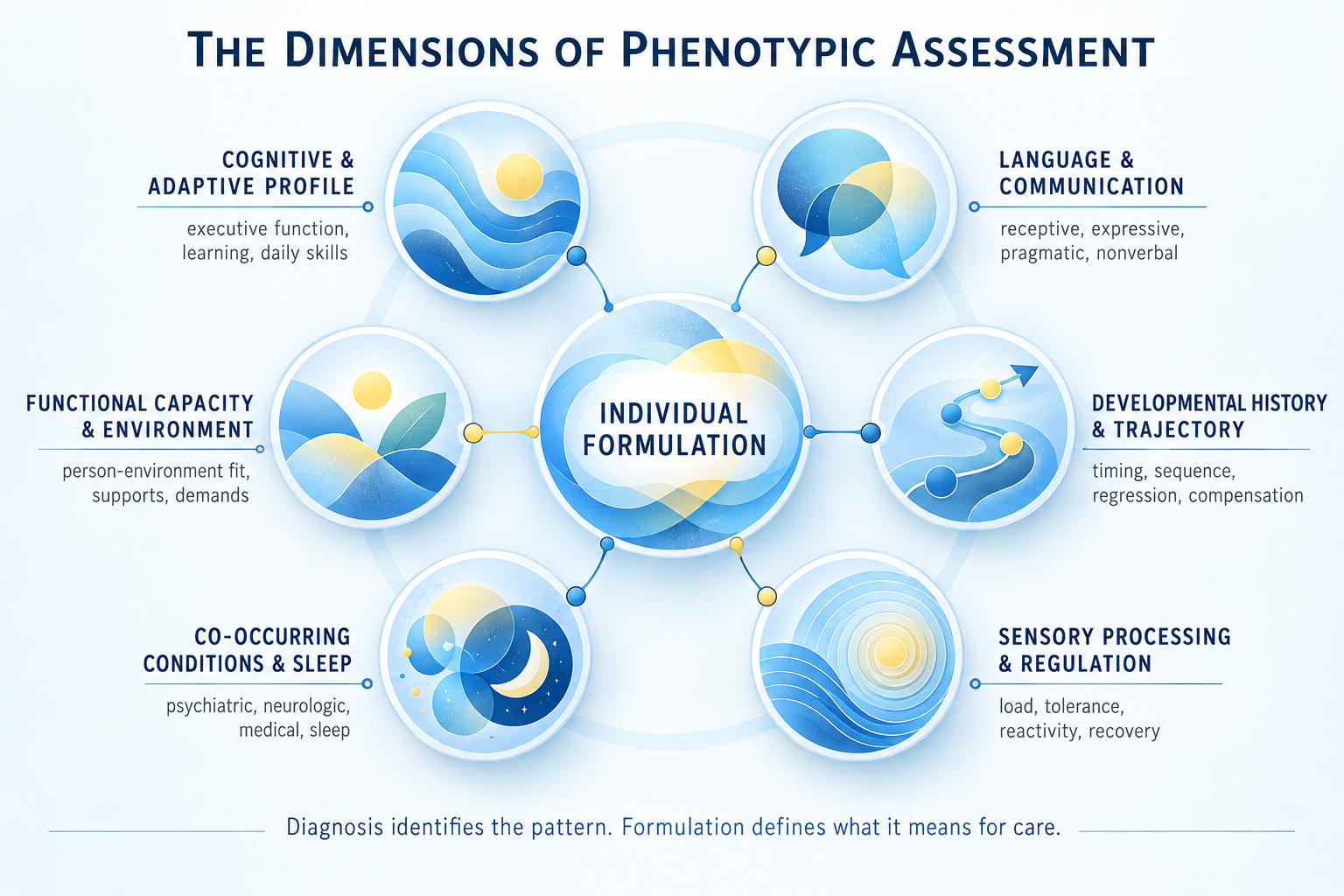
The second question converts assessment from a checklist into a formulation. Developmental history clarifies timing, sequence, regression, and compensation, not simply delay. Cognitive and adaptive testing shows variability in executive function and functional capacity. Communication is evaluated across receptive, expressive, pragmatic, and nonverbal domains instead of being measured only against normative language milestones. Co-occurring psychiatric, neurologic, sleep, and medical conditions enter the formulation directly rather than being appended to the diagnosis.
In my evaluations, the diagnosis identifies the pattern and the phenotype describes how that pattern is expressed in the person. Both are required before treatment planning begins.
The same diagnosis can represent very different clinical needs
Two people can meet the same diagnostic criteria and differ substantially in cognition, adaptive functioning, sensory processing, communication, executive function, emotional regulation, and support needs. DSM-5-TR builds this into the diagnosis itself through specifiers for accompanying intellectual impairment and language impairment and through separate severity levels for social communication and restricted, repetitive behavior.
One person may have preserved cognitive functioning alongside significant sensory and social strain. Another may have intellectual disability, minimal spoken language, and substantial dependence across activities of daily living. A third may function well in structured settings and decompensate when cognitive, sensory, or interpersonal demands exceed available capacity.
These differences are not minor variations around one presentation. They call for different assessment strategies, interventions, resources, and long-term planning. The purpose of multidimensional profiling is clinical precision.
The 2021 Lancet Commission on autism proposed “profound autism” as an administrative designation for autistic people with particularly high support needs, including the need for 24-hour access to an adult caregiver. Across three cohorts, 18 to 48 percent met its operational criteria. A 2023 analysis of U.S. Autism and Developmental Disabilities Monitoring Network data found that 26.7 percent of autistic 8-year-olds met related criteria, with higher rates of seizure disorders and self-injurious behavior and lower adaptive scores than other autistic children.
I use the term with a defined scope. It identifies a population whose needs are underrepresented in research and in public discussion of autism, and that function is legitimate. Many autistic adults object to it as a deficit-based label, and that objection is also legitimate. As a designation for service planning, the term is useful. As a substitute for individual formulation, it reproduces the problem this article describes: a category standing in for the person.
Behavior is an output
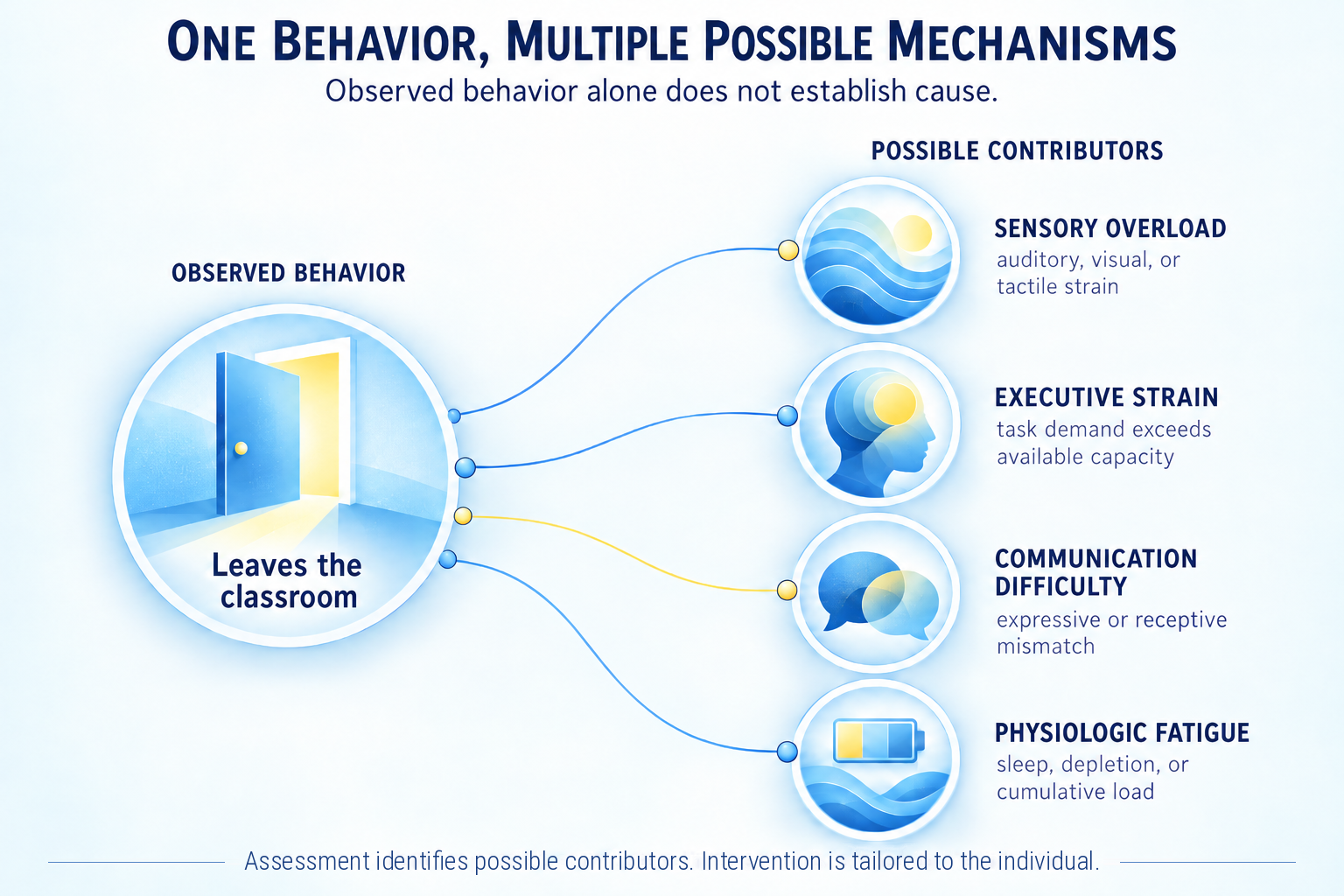
Behavior is observable. Mechanism is inferred. What presents as inattention, withdrawal, irritability, refusal, or noncompliance may reflect sensory overload, executive strain, physiologic fatigue, communication difficulty, or a mismatch between the person and the environment.
I document the observed behavior and the inferred mechanism as separate findings.
The conventional question asks how to reduce the behavior. The more useful question asks which physiologic, cognitive, sensory, or environmental mechanism is producing the behavior. A child who repeatedly leaves the classroom may be avoiding academic demands. The same child may instead be escaping auditory input that cannot be filtered. Repeated prompting is reasonable for the first mechanism and counterproductive for the second. The behavior alone does not settle the question.
Executive dysfunction may be downstream
Executive-function difficulty is common in autism. Its source deserves scrutiny. Difficulty initiating a task may reflect a primary executive deficit, or it may follow from sensory overload, cognitive fatigue, anxiety, disrupted sleep, excessive task complexity, or accumulated physiologic strain. In those cases, the apparent executive deficit is at least partly secondary.
The operative mechanism, or combination of mechanisms, determines the intervention. When task demand exceeds available cognitive capacity, repeated prompting does not create capacity. When sensory input is overwhelming, demanding greater tolerance does not reduce the input. When a person is physiologically depleted, reading reduced output as low motivation misidentifies the problem. The clinical task is to identify which mechanism contributes enough to impairment to warrant treatment.
Masking and environmental mismatch increase cumulative load
Autistic functioning cannot be assessed apart from the environment in which it is observed. A person may appear minimally impaired in one setting and significantly impaired in another. That variability is not inconsistency. Sensory conditions, predictability, social processing demands, and the compensatory effort required all differ between settings.
Camouflaging adds to that load. In a qualitative study of 92 autistic adults, Hull and colleagues described camouflaging as a combination of masking and compensation strategies, with exhaustion among its reported consequences. Raymaker and colleagues, using community-based participatory, qualitative methods with autistic co-researchers, proposed a model of autistic burnout as a syndrome arising from chronic life stress and a mismatch between expectations and abilities without adequate support. Participants described its primary features as chronic exhaustion, loss of skills, and reduced tolerance to stimulus.
In this context, anxiety, fatigue, withdrawal, and reduced executive capacity are not automatically independent disorders. Autistic people also develop primary anxiety, depressive, sleep, and attention disorders, and these can coexist with burnout or environmental strain. The temporal pattern, baseline functioning, and environmental demand inform the distinction. Some of these responses are proportionate to the demand placed on the person. The environment belongs in the formulation.
Intervention should follow mechanism
An assessment that does not change treatment has produced only a theoretical formulation. When sensory load is the dominant mechanism, environmental modification comes first. When executive strain is dominant, scaffolding, external structure, or task redesign takes priority over repeated prompting. When physiologic depletion is dominant, pacing, recovery, sleep, medical contributors, and cumulative demand become the focus. Co-occurring psychiatric and medical conditions require their own treatment.
Medication, psychotherapy, and occupational, educational, behavioral, and environmental interventions each have a role. They are not competing philosophies. The relevant question is whether a given intervention addresses the mechanism producing impairment in the person being treated.
Progress is not normalization
A mechanism-based approach also changes how outcomes are defined. Increased compliance is not progress by itself. Neither is suppression of visible autistic behavior, or closer resemblance to a neurotypical behavioral standard.
A person can appear more compliant while becoming more depleted. Visible distress can decline while compensatory effort rises. Behavior can normalize while the underlying mismatch persists. Meaningful progress is measured in regulation, preserved cognitive and physiologic capacity, functional stability, autonomy, and the fit between the person and the environment. The goal of treatment is that alignment.
From classification to precision
Phenotypic assessment does not replace the autism diagnosis. It makes the diagnosis clinically useful. The progression runs from classification to formulation, from behavior to mechanism, from deficits to patterns, and from normalization to alignment.
A diagnostic label identifies a category. The formulation determines what that category means for treatment. A diagnosis that leaves the formulation unchanged has not yet done its clinical work.
References
American Psychiatric Association. Diagnostic and Statistical Manual of Mental Disorders. 5th ed., text rev. Washington, DC: American Psychiatric Association Publishing, 2022.
Hughes, Michelle M., Kelly A. Shaw, Monica DiRienzo, et al. “The Prevalence and Characteristics of Children with Profound Autism, 15 Sites, United States, 2000–2016.” Public Health Reports 138, no. 6 (2023): 971–80. https://doi.org/10.1177/00333549231163551.
Hull, Laura, K. V. Petrides, Carrie Allison, Paula Smith, Simon Baron-Cohen, Meng-Chuan Lai, and William Mandy. “‘Putting on My Best Normal’: Social Camouflaging in Adults with Autism Spectrum Conditions.” Journal of Autism and Developmental Disorders 47, no. 8 (2017): 2519–34. https://doi.org/10.1007/s10803-017-3166-5.
Lord, Catherine, Tony Charman, Alexandra Havdahl, et al. “The Lancet Commission on the Future of Care and Clinical Research in Autism.” Lancet 399, no. 10321 (2022): 271–334. https://doi.org/10.1016/S0140-6736(21)01541-5.
Raymaker, Dora M., Alan R. Teo, Nicole A. Steckler, et al. “‘Having All of Your Internal Resources Exhausted Beyond Measure and Being Left with No Clean-Up Crew’: Defining Autistic Burnout.” Autism in Adulthood 2, no. 2 (2020): 132–43. https://doi.org/10.1089/aut.2019.0079.